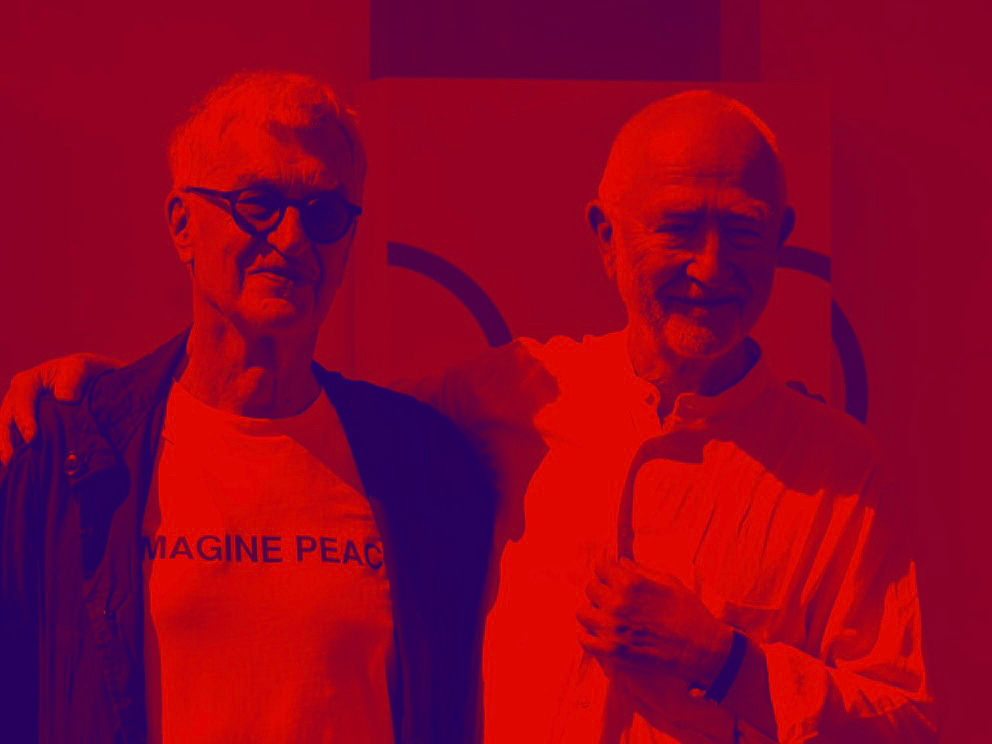
𝚆𝚒𝚖 & 𝙿𝚎𝚝𝚎𝚛

𝙵𝚛𝚘𝚖 𝙸𝚗𝚜𝚞𝚍𝚎 𝙾𝚞𝚝
𝚃𝚑𝚎 𝙰𝚛𝚌𝚑𝚒𝚝𝚎𝚌𝚝𝚞𝚛𝚎 𝚘𝚏 𝙿𝚎𝚝𝚎𝚛 𝚉𝚞𝚖𝚝𝚑𝚘𝚛
𝙰 𝙵𝚒𝚕𝚖 𝚋𝚢 𝚆𝚒𝚖 𝚆𝚎𝚗𝚍𝚎𝚛𝚜
𝚅𝚎𝚗𝚒𝚌𝚎 𝙵𝚒𝚕𝚖 𝙵𝚎𝚜𝚝𝚒𝚟𝚊𝚕 𝟸𝟶𝟸𝟼
Let others speak about you. Let others make the film.
To me, autobiography belongs more naturally to literature than to cinema. Cinema is not simply the editing and sequencing of footage about ourselves. Filmmaking becomes meaningful when the world of one person—whether an artist or a scientist—is seen and interpreted through another's eyes.
Perhaps that is why Wim Wenders’ encounter with the world of Peter Zumthor becomes such a profound experience: a filmmaker looking at architecture not merely to capture the shape of a building, but to reveal the feeling concealed within it.
From Inside Out is the result of more than fourteen years of Wenders accompanying Zumthor—fourteen years of searching for a cinematic language that moves beyond the surface of walls and reaches the memory hidden inside space. Through 3D imagery, the film transforms architecture from something merely observed into something physically inhabited. We do not simply look at buildings; we move through them, sense their distances, and come closer to their light, sound, materiality, and silence.
In one scene, a man stood in front of a painting at the Los Angeles County Museum of Art, inside the museum whose new building was designed by Peter Zumthor. His back was to the camera.
I became so excited that I suddenly said, half aloud, “Oh my God, that’s him!”
A few people around me looked at me strangely. When the film ended, they asked, “What happened?”
I said, “Wim Wenders was in the frame…”
No one else had noticed him.
For a moment, I doubted myself. Perhaps I had seen what I wanted to see. But I was certain it was him.
I remember people and their names in my own way. I register them in my mind through details I often cannot fully explain. The amount of information I have had to absorb at this stage of my life, in a relatively new field and throughout the years of migration, has been immense. Perhaps that is why I sometimes remember Wim Wenders less by his face than by his posture and clothes: his hands often tucked into his pockets, his long coat, and those familiar shoes.
Yes, I had not been mistaken. He was wearing the same kind of shoes I had noticed at the Berlin Film Festival and then recognized again on the red carpet in Venice.
Perhaps he, too, is a person of repetition, as I am—the repetition of habits, clothes, and familiar things.
The thought that several creators had somehow come together in a single frame filled me with joy: the painter whose work remained on the wall, the architect who had shaped the space around it, and the filmmaker who was now preserving both in his own image for the future.
Architecture is inherently history: a fragment of history that takes shape in a fixed geography and remains there.
An architect inscribes what exists within the mind—feeling, memory, childhood, and the past—onto the earth through wood, stone, iron, concrete, and cement. Perhaps for some architects, architecture is itself a way of confronting memory: a place where wounds, joys, fears, and recollections can reveal themselves without words, through material, light, form, and space.
When an architect designs a house, they are not thinking only about walls, windows, and the proportions between rooms. They are also imagining the life that will unfold within them—even the loves that may be born and grow inside that frame.
Perhaps they also think about ageing and death within that same space; about the day when one must eventually say goodbye to both the inside and the outside of a house before leaving it behind.
Every window, corridor, staircase, and quiet corner may one day become part of the emotional memory of those who live there.
We do not simply live in houses. We dream in them, fall in love in them, become afraid in them, grow old in them, and die in them.
Architecture, then, is not merely the construction of a physical shell. It is the design of a vessel for lives and memories that do not yet exist.
Wenders does not reduce Zumthor’s buildings to beautiful landscapes. His camera searches for the people who move through these spaces, work inside them, build them, or share their lives with them. The human body becomes the measure of architecture in the film: the sound of footsteps, a hand touching a wall, a pause before a window, the changing light across a face.
These gestures reveal the building's meaning.
The decision to shoot the film in 3D is not simply a technical display. The third dimension allows Wenders to turn the distance between the human body and space into part of the narrative itself.
Geometry is no longer abstract. It becomes a physical experience.
A wall seems to move toward us. A corridor gains depth. A ceiling casts its weight over the body.
Cinema attempts what architecture itself does: create feeling through space.
Many works of art could, at least in theory, be removed from the earth, sent to the moon, or suspended in a void. Architecture cannot.
Architecture must remain on the ground—whether intact and standing, or burned, ruined, and shattered.
Its significance may lie precisely in this condition of remaining: a presence bound to geography that, once built, becomes part of memory and history. Even when a building disappears, its absence remains part of that place's history.
And yet the film is not simply a celebration of an architect.
A quiet question runs underneath it: once a building has been completed, to whom does it belong?
To the architect who imagined it? To the workers who built it? Or to the people who lived inside it, loved there, suffered there, and created memories within it?
Perhaps the answer is that architecture begins in one person's mind but is completed through the presence of others.
I still find myself wondering which is more creative: the filmmaker who knows which angle, light, distance, and gaze to preserve for the future, or the architect who creates a space that will remain in history long after they are gone.
How fortunate we are not to have to choose between them.
I watched this film twice in a row at the Venice Film Festival.
It was presented in 3D, and I was grateful that my tears of joy remained hidden behind the dark glasses.
Geometry and physics, chemistry and music came together to create a beautiful, profound experience for me—one about space, memory, feeling, and permanence.
Selected Works by Peter Zumthor
Therme Vals, Switzerland — A building that seems to emerge directly from the mountain. Stone, water, steam, sound, and body temperature all become elements of the architecture.
Kunsthaus Bregenz, Austria — A cube of glass and concrete that absorbs and diffuses natural light, taking on a different character at different times of day.
Kolumba Museum, Cologne — A new structure built within and over the ruins of a historic church. Here, architecture does not conceal the past; it allows the wound of history to remain visible.
Bruder Klaus Field Chapel, Germany — Its interior was formed using tree trunks as a temporary mould, which were later burned away inside the structure. Fire shifts from a destructive force into part of the creative process, leaving its traces permanently on the walls.
Saint Benedict Chapel, Switzerland — A wooden building set into a mountain landscape, where serenity comes from simplicity of form and harmony with the surrounding environment. It feels less like a structure dominating nature than one quietly seated within it.
Steilneset Memorial, Norway — A memorial to those who were tried and executed on accusations of witchcraft. Zumthor’s long-suspended structure, placed alongside Louise Bourgeois’ installation, turns the memory of violence into a bodily experience.
Serpentine Pavilion 2011, London — Dark walls separate visitors from the noise of the outside world before opening suddenly onto a living garden at the heart of the structure: a brief journey from darkness toward light and life.
Swiss Sound Box, Expo 2000, Hanover — A temporary structure made from stacked timber that connected architecture to sound, scent, and touch. Its sensory memory outlasted the building's physical life.
David Geffen Galleries at the Los Angeles County Museum of Art (LACMA) — A building that organizes the museum’s permanent collection across a broad horizontal level and seeks to create a freer relationship between artworks, people, light, and the city.
Wim Wenders and Peter Zumthor: two creators, two languages, one shared world.
One creates space. The other preserves its passage through time.


