𝚃𝚑𝚎 𝙲𝚘𝚊𝚝, 𝚃𝚑𝚎 𝙿𝚛𝚒𝚌𝚎 𝚘𝚏 𝚂𝚝𝚊𝚢𝚒𝚗𝚐 𝙰𝚕𝚒𝚟𝚎

𝙳𝙰𝚄
𝙳𝚒𝚛𝚎𝚌𝚝𝚎𝚍 𝚋𝚢 𝙸𝚕𝚢𝚊 𝙺𝚑𝚛𝚣𝚑𝚊𝚗𝚘𝚟𝚜𝚔𝚢
𝚅𝚎𝚗𝚒𝚌𝚎 𝙵𝚒𝚕𝚖 𝙵𝚎𝚍𝚝𝚒𝚟𝚊𝚕 𝟸𝟶𝟸𝟼
I was seven years old when I saw a mother standing outside a prison gate. Her image has never left me.
Her son was one of four friends who held similar beliefs, opposed the ruling system, and fought against it. All four had been sentenced to death. They were told that if they signed a statement of repentance, they could be released, provided they reported to the authorities every month afterward.
Three signed and survived. The fourth refused to repent. On the night before his execution, he divided his clothes and personal belongings among his friends. His coat went to one of the three who had escaped execution by signing the statement.
After her son’s execution, the mother saw his coat on the surviving friend. She went to him, held the coat in her arms, kissed it, and breathed in its scent, as though her son’s body were still somewhere among its threads. I have carried that image since I was seven: the coat of a man who would not repent to save his life, worn by a friend who survived by accepting the system’s terms.
Throughout DAU, I kept thinking of that scene: of an executed man’s coat on the body of someone who had survived, and of why Dau wears red amid so much gray. In my memory, the coat I saw as a child and the one Dau wears came together. His red coat evokes life, individuality, and the trace a person leaves behind. As Dau yields, step by step, to the logic of power, the coat need not change color for its meaning to be lost. The system so dulls people’s five senses that they can no longer see the red of Dau’s coat. Sometimes the body survives after part of a person’s conscience, friendship, and identity has already been executed.
From the outset, DAU refuses the calm, linear course of a conventional biopic. Rapid cuts, insistent music, and an onrush of images draw us into Dau’s mind before we can make orderly sense of what we see. The shots arrive like intrusive thoughts: fragments of the past, intimations of the future, nightmares that disturb the boundaries between memory, premonition, and the present. Editing here does more than move the story along. It establishes how the film thinks.
The images acquire a surreal quality through associations that defy ordinary time and causality. Their treatment is expressionist: cuts, music, color, and agitated movement bend the visible world under Dau’s psychological pressure. This is no retreat into a dream detached from history. The film gives political fear a sensory form. Surreal associations and expressionist execution work together, one unsettling the logic of what we see, the other making its emotional force difficult to escape.
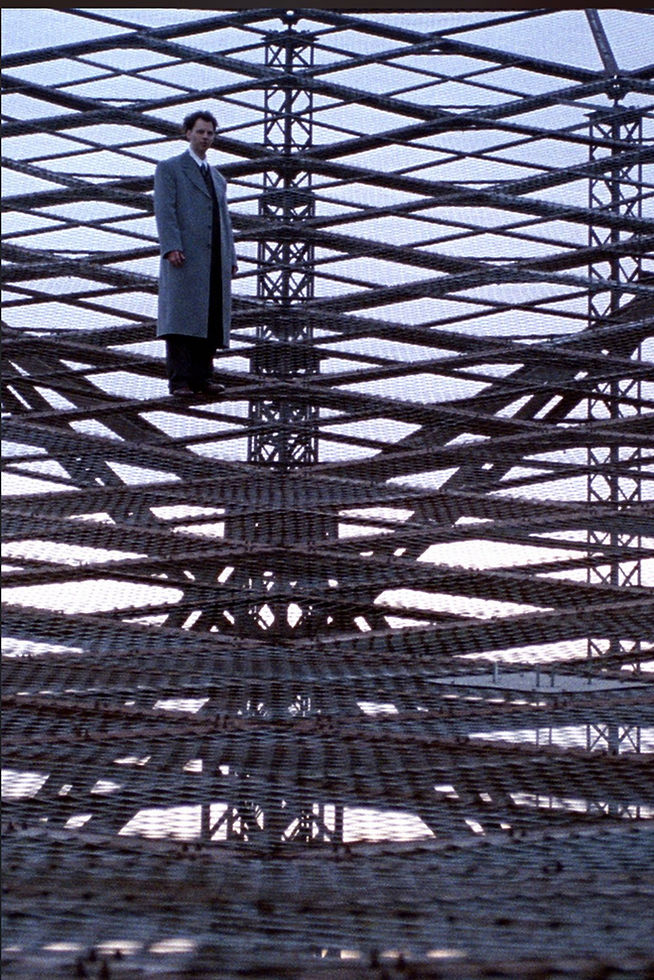
Among the opening images is a building that people climb like lifeless bodies before falling from its heights. Their movement does not resemble the ascent of living people acting of their own free will; it is as though some external force were moving them. Here, rising offers no promise of progress or liberation. Every ascent may be the prelude to a fall. What first appears nightmarish acquires a clearer political meaning as the film proceeds: power lifts people up, uses their minds and abilities, then lets them fall when it no longer needs them. Instead of sheltering life and learning, the building becomes a machine for swallowing bodies and casting them out.
The hammer, sickle, and star are familiar Soviet symbols. Above the entrance to Dau’s institute, however, a human brain takes the star’s place. In a single image, the film makes the relationship between science and power visible. A brain that might signify independent thought now completes the state’s insignia. Science has not displaced ideology; it has been absorbed by it. The government needs the scientist’s intelligence, but not his independence. Before Dau enters the building, the sign above its door has already claimed his mind.
The telephones crowded onto Dau’s desk extend the same visual argument. A place for study and thought becomes a junction for orders, information, and surveillance. Any ring might bring an instruction, news of someone’s disappearance, or the reminder that a conversation can be overheard. Dau sits at the center of a network of voices without controlling it. The telephones let him speak while making him conscious of being heard. The state has reached even the surface on which he works.
Nor does the camera simply separate Dau from the crowd and elevate him into an exceptional hero. It continually measures his relationship to the building, its corridors, and the people around him. Deep compositions and crowded staging allow us to feel the pressure of the collective and of surveillance even when no one is being openly interrogated. As the camera moves among bodies, unpredictable encounters remain alive within the frame; enclosed rooms and watchful objects, meanwhile, leave the character little room to escape. The building is more than a backdrop for the action. It shapes how people move, pause, and speak.
The 35 mm footage gives much of the film a grainy, bodily texture. Smoke, darkness, dust, and worn colors settle on people and objects; the past feels inhabited rather than displayed. The images are beautiful, but their beauty offers no refuge. Jürgen Jürges, Lol Crawley, and Manuel Alberto Claro worked as cinematographers on the film. What stays with me is the coherence of the visual world Khrzhanovsky has made with them: bodies, rooms, and crowds belong to the same oppressive space, even as the story crosses different periods of Dau’s life. The film’s changes of pace belong to its narrative movement, not to a fragmentation of its visual form.
The performances carry this struggle for agency into human relationships. Teodor Currentzis plays Dau without settling him into the familiar posture of the persecuted genius. Among the other people in a scene, his authority as a scientist never guarantees control of the encounter. The performance holds conflicting positions together: a man constrained by the state who can still exercise distance and privilege in his own relationships. The more completely the institute takes hold of Dau, the harder it becomes to separate his brilliance from his compromises. Currentzis keeps that tension visible rather than resolving it into innocence or guilt.
Around him, performers and participants from different backgrounds give the crowded scenes an unstable quality, somewhere between acting and living through an encounter. A pause, a glance, a silence, or the movement of someone in the background can make hierarchy felt before any dialogue explains it. Khrzhanovsky directs these presences as part of the drama, rather than treating the crowd as historical decoration. Dau is the center of the story, but never the center of power. The closeness between performance and everyday behavior also makes the ethics of this production impossible to separate from its artistic method.
Before it is simply a biography of Lev Landau, DAU is a dissection of a world in which science, the body, love, fear, and memory must all pass through the filter of power. The institute is a workplace for scientists, but also an environment that regulates relationships, monitors conversations, and restricts desire and personal choice. Set design becomes the design of a political order. Everyone must know their place, weigh their words, and perform the role permitted to them. Everything may look like an enormous performance, yet the fear, humiliation, and punishment depicted have a physical weight that the staging never lets us forget.
Animal heads and carcasses belong to the same visual logic. Death repeatedly enters through animal bodies, unsettling the distance we assume between those bodies and our own. The force of these images lies in their placement: edited into the life of the institute, they make us see what happens when a person is treated as experimental material, a useful instrument, or a disposable being. They become part of the film’s argument rather than macabre decoration.
At first Dau may appear to be a victim of the system, but the film shows how fragile the boundary between victim and collaborator becomes under totalitarianism. To stay alive, continue his work, and retain his position, he gradually goes along with the system that devours his friends and those around him. His involvement in the atomic bomb project is more than a scientific decision.
It is an ethical moment in which knowledge is separated from human responsibility and placed at the service of power. The brain we saw above the institute’s entrance now delivers the fruits of its work to the apparatus that claimed ownership of it.
The film does not limit torture to blows, interrogation, or execution. Its ongoing torture is the demand that people internalize the gaze of power: censor themselves before speaking, suspect those closest to them, and treat the system’s conduct as normal in order to go on living. Telephones, rooms, corridors, and watchful eyes turn the institute into a human laboratory, where not only physics but fear, obedience, and betrayal are put to the test.
While watching, I thought of a museum in Berlin that displayed methods of control and torture in East Germany. In one room were hundreds of sealed jars or containers, each holding a piece of cloth bearing a person’s scent—samples that officers could give trained dogs to help identify or track someone. In my memory, the liquid in some of the containers looked like a human urine sample. What stayed with me was the logic of the collection: power could turn even a person’s scent and most intimate bodily trace into a security file.
That memory connects to the world of DAU, where scientists, doctors, chemists, and technicians can knowingly—or simply through obedience—place their expertise at the disposal of an apparatus devoted to controlling people. The violence of a system is not produced by interrogators and executioners alone. To endure, it needs a network of specialists, each making some small, apparently neutral part of repression possible. The question is not only how power uses science, but when those who possess knowledge decide not to see their human responsibility for the results of their work.
The film’s production carries this question beyond the story. Conceived as a biography of Landau, DAU grew into a multidisciplinary project at the intersection of cinema, performance, and lived experience. An institute was built in Kharkiv, Ukraine, where actors, scientists, artists, and others participated in years of filming that yielded hundreds of hours of material. Two other films, DAU. Natasha and DAU. Degeneration, screened at the 2020 Berlinale; the Venice film places Dau himself at the center. Its long interval between shooting and editing matters to what we see. Working with editors Ilya Permyakov and Rob Myers, Khrzhanovsky shapes material from different periods into a coherent narrative. Its changes of speed follow the story’s demands: the rush of images at the outset, and the different rhythms through which Dau’s choices and their consequences unfold. Directing such varied material toward a unified experience is one of the film’s achievements.
The ambition of this method leaves an ethical question that belongs in a reading of the film. Reports have raised concerns about psychological pressure, humiliation, and participants’ autonomy during production; the filmmakers have disputed allegations about their methods. I cannot infer any individual’s experience from what appears on screen. But a film that makes coercion its subject also invites scrutiny of how those who helped create it were treated. If the recreation of domination entails comparable power relations behind the camera, its achievement carries a contradiction that cannot be resolved by artistic ambition alone.
At the end, men who act like faceless, unseeing agents arrive with glass enclosures and destroy the institute, its people, and the traces of the project. Glass allows us to see, but here seeing does not mean understanding.
They carry out their task without wanting, or being able, to see what they are destroying. The building in the opening images and the falling bodies have now passed from nightmare into the concrete logic of government: a system that uses scientists’ minds to build a bomb can erase those same people, and every trace of their work, when the task is done. Loyalty provides no safety. It only delays the moment of elimination.
In DAU, the coat, the telephone, the wall, the corridor, the brain above the entrance, and the glass enclosure are not mute elements of set design. Each carries a stage in the relationship between human beings and power. The film first builds that relationship through rhythm and the turmoil of Dau’s mind, then gives it physical form in the building and its objects, and finally brings it to an end through performing bodies and the work of erasure. The film’s question, then, is not only what one scientist did in the face of the state. It is also what happens to our capacity to see when a system can leave a red coat in plain sight and teach us to overlook its color.


