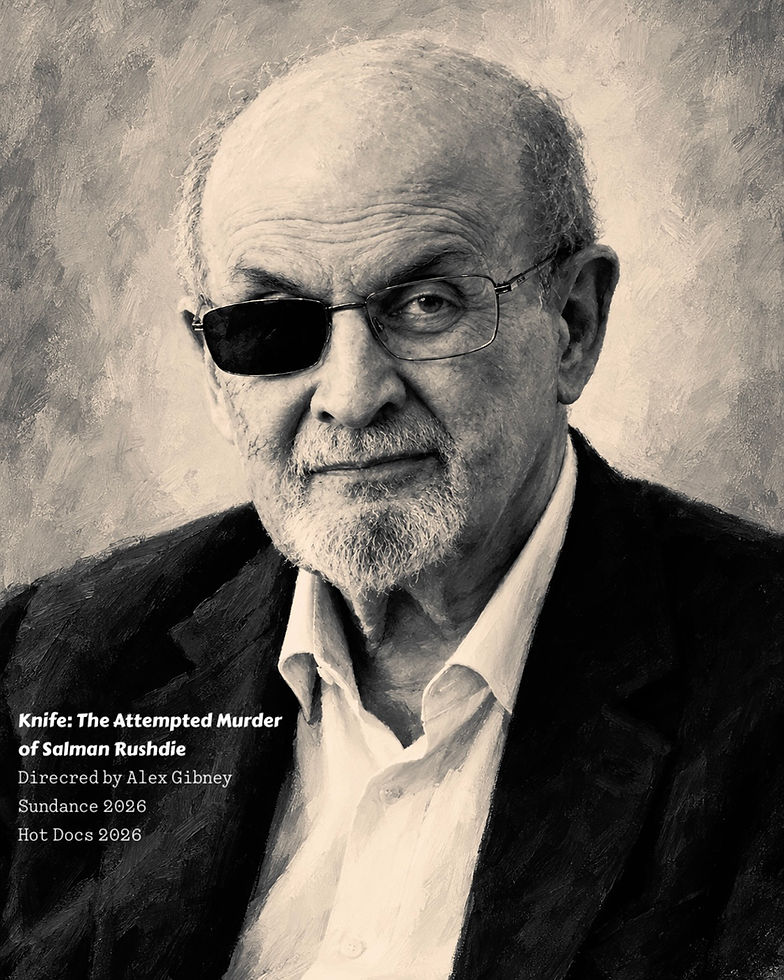
The Architecture of Two Wounds

𝙺𝚗𝚒𝚏𝚎: 𝚃𝚑𝚎 𝙰𝚝𝚝𝚎𝚖𝚙𝚝𝚎𝚍 𝙼𝚞𝚛𝚍𝚎𝚛 𝚘𝚏 𝚂𝚊𝚕𝚖𝚊𝚗 𝚁𝚞𝚜𝚑𝚍𝚒
𝙳𝚒𝚛𝚎𝚌𝚝𝚎𝚍 𝚋𝚢 𝙰𝚕𝚎𝚡 𝙶𝚒𝚋𝚗𝚎𝚢
𝙷𝚘𝚝 𝙳𝚘𝚌𝚜 𝟸𝟶𝟸𝟼
𝚂𝚞𝚗𝚍𝚊𝚗𝚌𝚎 𝟸𝟶𝟸𝟼
&
L’Abandon
𝙳𝚒𝚛𝚎𝚌𝚝𝚎𝚍 𝚋𝚢 𝚅𝚒𝚗𝚌𝚎𝚗𝚝 𝙶𝚊𝚛𝚎𝚗𝚚
𝙲𝚊𝚗𝚗𝚎𝚜 𝟸𝟶𝟸𝟼
When Reality Is More Powerful Than Cinema
Knife is a powerful film, but the question that stayed with me after it ended was this: how much of that power comes from Alex Gibney’s direction, and how much comes from the force of reality itself?
The film has extraordinary material at its disposal: Salman Rushdie’s own narration, his writing, archival footage, Rachel Eliza Griffiths’s private videos from the hospital and his recovery, and finally the real footage of the attack itself. This material is so powerful in its own right that at times the filmmaker seems to recede before it.
For me, the central issue begins precisely here. A documentary based on a book should not simply become an illustrated version of that book. Cinema should add something: structure, distance, discovery, analysis, or a new way of seeing.
In Knife, I sometimes feel that Rushdie’s book, rather than serving as raw material for the film, ends up controlling the film’s structure. Family footage and archival images sit alongside his narration, but the filmmaker's independent presence is not always equally perceptible.
That leaves me with a simple but fundamental question: if we remove Rushdie’s book, his wife’s private footage, the historical archive, and the real footage of the attack, how much of the director’s independent vision remains?
This question does not diminish the film's importance. On the contrary, Knife is an important document and, at times, deeply affecting. But in evaluating a documentary, we need to distinguish between the power of the subject and the power of filmmaking.
Paradoxically, the parts of the film that try hardest to add something to reality are, for me, among its weaker elements. The animated sequences have neither the force of the real images nor enough depth to expand Rushdie’s inner world meaningfully. In a film that already possesses a real wound, a real hospital, real pain, and the real return of a human being to life, these images sometimes create an artificial distance between the viewer and reality rather than adding another layer of meaning.
The film’s numerous references to cinema history do not always fully integrate into its texture either. If the intention is to show that Rushdie understands his personal experience through cinema, that relationship could have been constructed more deeply and systematically. As it stands, some of these references feel more decorative than necessary; they make the film feel more constructed without necessarily adding meaning.
And yet, the more I think about the film, the more seriously I consider the possibility that the filmmaker’s retreat is not always a weakness. Perhaps part of Knife’s project is precisely to contain anger rather than generate it.
In many moments, Rushdie speaks as though he is not addressing only the attacker from the past. It is as if he is also speaking to someone in the future, someone who might one day be tempted to follow the same path. His tone is less one of revenge than of a soft, deliberate statement: an attempt to interrupt the same trajectory that moves from idea to anger, and from anger to violence.
This becomes especially significant in his encounter with his attacker. The film could have turned this moment into an emotional duel, but it does not. The confrontation is almost wordless. We expect anger to intensify, but silence does the opposite: it lowers the temperature.
The film refuses to allow the attacker to become the center of the narrative again.
Rushdie remains at the center: a man who survived, who speaks, jokes, and refuses to let his entire identity be reduced to the wound another person left on his body.
From this perspective, silence is not merely the absence of dialogue; it becomes a narrative and even an ethical choice. The film refuses to answer violence with another form of violence in language or image.
This approach reminded me of L’Abandon, directed by Vincent Garenq, about Samuel Paty. The two films do not belong to the same genre; one is a documentary, the other a dramatic reconstruction of a real event. But both confront real violence, and because their forms differ, the comparison becomes meaningful.
L’Abandon reconstructs the final eleven days of Paty’s life: the classroom, misunderstanding, rumour, social media, protest, pressure, institutional hesitation, escalating danger, and finally murder. The film’s power lies not simply in reconstructing the event, but in revealing the path that made the event possible.
The power of L’Abandon lies not only in the devastating nature of its subject, but in the filmmaking itself. Garenq’s direction is precise, the performances are exceptionally strong, the narrative flows with remarkable clarity, and the editing steadily intensifies the dramatic pressure without ever feeling rushed. Each scene prepares the next, and the story moves with such control that the viewer does not merely know where it is heading, but gradually understands how everything arrives there. Its visual force comes from that same control: the mise-en-scène, rhythm, distances, glances, and silences all contribute to an atmosphere of anxiety that slowly takes over the film.
In that film, anger does not appear suddenly. It is created, transmitted, reproduced, and gradually transformed from a narrative into a physical act.
That is why Paty’s death feels so devastating. The pain does not come only from knowing his fate. The viewer watches a sequence of moments in which the course of events might perhaps have been changed, but was not. Our anger comes from this accumulation.
Another difference between these two fates matters deeply to me. Salman Rushdie is a writer: he writes, his work is published, it separates from him and enters the world. Samuel Paty, however, was a teacher, someone who stood in front of a younger generation every day and taught history, freedom of expression, and the possibility of questioning. One was targeted for something he had written; the other for something he was trying to teach.
That distinction takes the murder of a teacher beyond an individual tragedy. When a teacher is killed because of something taught in the classroom, violence does not reach only one body; it enters the space of education itself. It enters the classroom, the memories of students, colleagues and families, and can cast a shadow for years over a school, a town, and even a country’s collective memory.
A school, which should be a place for questions, dialogue and disagreement, suddenly begins to carry the memory of violence within it.
And perhaps this is where the necessity of both films becomes clear. Knife records the wound that violence leaves on the body of a writer and follows his return to life; L’Abandon shows how the killing of a teacher can move beyond one victim and become a collective wound. One exercises freedom of expression through writing; the other tries to teach its meaning to the next generation. In both cases, what is targeted is not only an individual, but the possibility of transmitting thought.
But Knife chooses a different path. Gibney shows the consequences of anger more than the architecture that produces it. We see the wound, survival, the return to life. Still, we enter less deeply into the process that explains how this anger was preserved across decades, transmitted, and ultimately transformed into an attack.
At first, I experienced this as a kind of absence.
But perhaps this is precisely where the ethical difference between the two films emerges: L’Abandon follows anger to show how a murder is made possible; Knife may deliberately avoid following it all the way, so the film itself does not become part of the cycle that reproduces anger.
And this is where the title Knife begins, for me, to mean something beyond the weapon used in the attack.
A knife is a neutral object. The same blade that, in an operating room, can cut into the body to save a patient’s life can, somewhere else, cut into that same human body and take a life. The difference is not in the tool itself, but in the hand that holds it, the intention that directs it, and the world of meaning constructed before the blade ever touches flesh.
Perhaps this contradiction is one of the most disturbing dimensions of the film’s title. A knife can be an instrument of healing or an instrument of killing; something that opens the body to save it, or cuts into it to destroy.
A knife, unlike many weapons, also requires proximity. The attacker has to reach the victim’s body. Violence that may have travelled for years through words, images, ideology, propaganda and narrative eventually becomes material in the very short distance between two bodies.
In this sense, the knife becomes the point at which the abstract turns into matter: the place where a fatwa, anger, misunderstanding, propaganda or ideology descends from the level of language and inscribes itself onto the human body.
Perhaps that is why, for me, simply seeing Salman Rushdie’s wound is not enough.
The question is to see the architecture of that wound.
How can a threat rooted decades in the past remain alive and become violence again? How can an idea or an order detach itself from its original time and place and, years later, target a human body? How does anger move from one generation to another, from one medium to another, from one narrative to another?
In Samuel Paty’s case too, violence does not begin at the moment of murder. It begins much earlier: in the alteration of a narrative, in the circulation of an image, in rumour, in the reproduction of anger, and in the hesitation of institutions that might have intervened.
From this perspective, the ending of Knife is, for me, the film’s strongest and most important section.
The real footage of the attack, the shape of the venue, the openness of the stage, the speed of the attacker’s charge and the reactions of the audience make the event comprehensible without requiring additional explanation.
Here, the image does not merely bear witness; it analyzes.
We do not simply see what happened. To some extent, we understand how it became possible. The openness of the space, the short distance, the speed of the event and the reactions of ordinary people all become part of our understanding.
In this moment, the film explains the least and achieves the greatest impact.
And perhaps this section reveals what is missing elsewhere in the film: not merely an account of what happened, but an attempt to show how it became possible.
In the end, Knife is, for me, a film about survival—but survival understood in the shadow of the possibility that violence can return. Rushdie survived, but the threat does not belong entirely to the past.
Perhaps this is why both his tone and the film's tone remain so controlled.
It is as though the film is speaking not only to one attacker from the past, but to the possibility of attackers yet to come.
In this reading, the silence of the encounter with the attacker becomes more important than any dialogue. The film refuses to construct a scene of revenge and refuses to allow anger to seize control of the narrative once again.
So perhaps the central contradiction of Knife lies here: on the one hand, the film does not go deeply enough into the mechanisms that produce violence; on the other, that very restraint may itself be part of its ethical position.
For me, Knife is an extraordinarily powerful encounter with reality, but not always an equally powerful transformation of reality into cinema.
And perhaps its finest moments are precisely those in which the film leaves the smallest possible distance between us and reality.


