𝚂𝚞𝚖𝚖𝚎𝚛 𝙼𝚎𝚊𝚍𝚘𝚠 𝙻𝚘𝚌𝚊𝚛𝚗𝚘 𝟸𝟶𝟸𝟼

Updated: Aug 19
𝚂𝚞𝚖𝚖𝚎𝚛 𝙼𝚎𝚊𝚍𝚘𝚠
𝙳𝚒𝚛𝚎𝚌𝚝𝚎𝚍 𝚋𝚢
𝙽𝚊𝚎̈𝚕 𝙺𝚑𝚕𝚎𝚒𝚏𝚒 & 𝙻𝚒𝚜𝚊 𝙳𝚎𝚋𝚊𝚞𝚌𝚑𝚎
𝙻𝚘𝚌𝚊𝚛𝚗𝚘 𝟸𝟶𝟸𝟼
Art, Observation, and Three Forms of
Before becoming a shepherd, Lisa was an artist. She painted and created sculptures from discarded car parts, old engines, and objects that others considered useless. Her work was rooted in a particular way of seeing: recognizing a new possibility in something that had lost its original function and been cast aside.
When the university closed during the pandemic, Lisa left the city and returned to the Cévennes, where she lived in a caravan. She continued painting for a while, but eventually realized that she could no longer remain indoors and merely make art about life. To nourish art—and life itself—one had to leave the house and do something.
A neighbour entrusted his flock to her, pointed toward a hill, a pasture, chestnut trees, and a river, and asked her to take the sheep out to graze. That day marked the beginning of a path she would follow for nearly two years.
Choosing shepherding did not mean abandoning art; Lisa merely changed her material. Iron and worn-out mechanical parts gave way to soil, rain, animal bodies, birth, and death. The same sensitivity that once enabled her to create sculptures from discarded objects now shapes her relationship with nature and living beings.
Summer Meadow, or L’Estive, directed and co-written by Naël Khleifi and Lisa Debauche, appears to be about Hana, a young French-Lebanese woman who left Lebanon with her family at the age of thirteen during the war. She now lives in the French Alps as an apprentice shepherd, though she does not yet know whether the mountains represent the beginning of a new life or merely an interruption that lets her distance herself from the past.
Through Hana’s encounters with Lisa and two migrants, the film places three forms of freedom alongside one another: freedom as the right to choose, freedom as the possibility of movement, and freedom as responsibility toward others.
The Mountain as Refuge, Border, and Passage
The direction by Khleifi and Debauche, Diego Romero Suarez-Llanos’s cinematography, and the film’s precise editing transform the mountain from a beautiful backdrop into a dramatic space. The wide shots establish the relationship between nature's vastness and human vulnerability. The meadows, fog, wind, storms, isolated cabin, and moving flock evoke both serenity and danger.
This geography means different things to each character. Hana has taken refuge there to distance herself from the past; migrants cross it in search of another life; the police monitor it as a zone of control; and Lisa lives and works within it. The same landscape can therefore become a sanctuary, a passage, a home, or a border, depending on who is moving through it.
The film also constructs a visual language through blue, yellow, and orange. Blue is associated with Hana’s isolation and inner coldness. Yellow appears in the light and dry grass, suspended between vitality and decay. Orange enters the image through a jacket abandoned in the mountains, immediately separating itself from the natural palette and becoming a warning signal.
A photograph of a young boy found inside the jacket transforms the garment from an ownerless object into evidence of an absent human being. A radio report about the discovery of an unidentified body connects these two details. Their visual and narrative combination makes the danger of crossing the border palpable. We may initially imagine that the owner of the jacket has been arrested, lost his way, or simply become unable to continue. Eventually, the film appears to confirm that his body has been found.
At such moments, the viewer is placed in the same position as the characters. The mountains are filled with signs whose complete meanings remain inaccessible. In this landscape, a discarded piece of clothing may be the only trace left by someone who has already disappeared from the frame.
Hana and the Fear of Failure
After one of the ewes dies, Hana does not report the incident. When Lisa asks why she concealed it, Hana replies:
“I am not allowed to make mistakes.”
This sentence clarifies her condition. Hana believes that because she is not originally from France, others are waiting for her to fail. Being a woman in a profession where she must continually prove her competence intensifies that pressure; being an immigrant adds another layer of anxiety. Admitting to a mistake would not merely mean acknowledging a professional failure. For Hana, it would confirm the judgment she imagines has already been made about her.
Her fear of failure leads not to greater responsibility but to silence. The animal’s death therefore becomes more than an incident involving the flock: it reveals a crisis in which fear of judgment has deprived Hana of the ability to respond appropriately.
The recurring image of Hana’s motionless fingers while she sleeps translates this condition into bodily language. The camera lingers on a hand that seems to have lost its capacity to touch or react. The lifeless limbs of the dead ewe later echo the image. One body is dead; the other remains alive but has been immobilized by depression, anxiety, and guilt.
Hana says she loves the flock, yet while walking through the pasture her mind is elsewhere. Lebanon is continually present in her thoughts, and the security she has found in France has not replaced her attachment to the country she lost. She has neither decided to return nor transformed remaining in France into a conscious choice.
Costume design completes this separation between physical and emotional presence. Hana’s new professional jacket, backpack, trousers, and shoes were purchased for life in the mountains, but her outward preparation does not match her inner state. Her equipment resembles armour intended to contain fear. The packaged, ready-made food she consumes similarly suggests that she has not yet adapted to the rhythms of her new environment.
Lisa, by contrast, works in jeans and simpler clothes. Getting wet does not stop her, and she does not need specialized clothing to establish her professional identity. The visual difference between the two women reveals the distance between equipping oneself for an experience and actually living it:
Hana is dressed as a shepherd; Lisa tends the flock.
Observation as Responsibility
Lisa says that the essence of shepherding lies in observation. In the morning, she prepares her coffee, enters the flock, and spends time among the animals. She watches to determine which sheep has been injured, which ewe is about to give birth, and which lamb has lost its mother.
She can even imitate the sound of an ewe to help a lamb locate its mother. She knows that an ewe’s voice becomes deeper when she calls her offspring and that a shepherd must be able to hear such subtle distinctions.
In Lisa’s world, looking is not a passive act; observation is the beginning of care. Anyone who truly sees cannot remain detached from what has been seen. This principle connects her artistic past, her work as a shepherd, and her relationship with the people around her.
Her attentiveness also enables her to recognize Hana’s psychological state. She does not seek emotional intimacy with her or adopt the role of saviour. Instead of offering theatrical sympathy, she asks a few questions and suggests that perhaps Hana could have a flock of her own in Lebanon.
The suggestion does not determine Hana’s future, but it gives practical form to a previously abstract longing. For the first time, returning to Lebanon is imagined not only as an emotional response to exile but as a life Hana might actively build.
Migration as Choice and Compulsion
The arrival of two migrants at the cabin places Hana’s experience beside another form of departure. She speaks in Arabic with a young man who left Morocco at nineteen and has spent nearly two years travelling through Turkey, Greece, Bosnia and Herzegovina, Montenegro, and several other countries.
He did not leave Morocco to escape a war. He wanted to discover the world, meet new people, and experience different cultures, but he had no legal means of making such a journey. Despite the police, hunger, forests, loneliness, and prolonged periods without contact with his family, he does not describe his route only as a catalogue of suffering. He speaks about what he has seen, the people he has encountered, and the freedom he has experienced through movement.
Hana left Lebanon at thirteen because of war and without any personal choice. France can therefore feel like a prison to her despite the safety it provides. The Moroccan traveller, by contrast, has neither a home nor legal status, yet he describes himself as free.
For one person, leaving the homeland is a wound produced by forced displacement; for another, it becomes a means of discovering the world. The distinction lies not simply in the destination or the difficulty of the journey, but in whether departure was chosen or imposed.
The young man asks Hana why she does not leave France if she feels imprisoned there. His question exposes the contradiction in her life: her family is in France, her heart remains in Lebanon, and she has not yet chosen a path that truly belongs to her.
Their conversation changes the meaning of departure for Hana. Until that moment, leaving home had been associated with war, compulsion, and loss. She now encounters someone for whom movement has offered knowledge, connection, and the possibility of beginning again. The film does not provide a definite answer about Hana’s future, but it restores the possibility of making a decision.
Lisa’s Everyday Resistance
Lisa’s relationship with the migrants reveals that shepherding does not encompass her entire identity. She and the people connected to her know the mountain routes and help travellers avoid the police. Lisa prepares food and tea, explains where they might find a phone signal, and offers one of them her own bed.
The film reveals this activity without announcing it directly. Alongside being Lisa’s profession, shepherding may provide a natural cover for moving through the region and assisting people who need to cross the border. This dual existence recalls the underground network depicted in the television series Secret Army: individuals whose ordinary occupations concealed their work helping fugitives escape capture.
Lisa’s smoking, composure, and unassuming behaviour initially seem like ordinary character details, but take on another meaning once her connection with the migrants becomes visible. She must control information and conceal her purpose from those monitoring the area.
She does not use others' suffering to construct a moral image of herself. Helping is neither a political declaration nor a performance of heroism; it is an understated part of her daily life.
Her discussion of Islamic slaughter, inspired by a Muslim friend, also shows that her relationship with animals is not merely professional. A conversation about killing, suffering, and human responsibility develops into a critique of capitalism: a system in which people pay to endure greater suffering and must even purchase a piece of land in which their bodies can be placed after death.
This bitter irony is expressed in a landscape where migrants may disappear without names or graves. The ownership of burial ground is set against bodies that may never be returned to their families.
Manal Issa’s Presence, Sibylle Bataille’s Performance
Manal Issa gives an inward-looking performance as Hana. Her distant gaze, pauses, and restrained physicality suit a character suspended between two countries and two possible decisions.
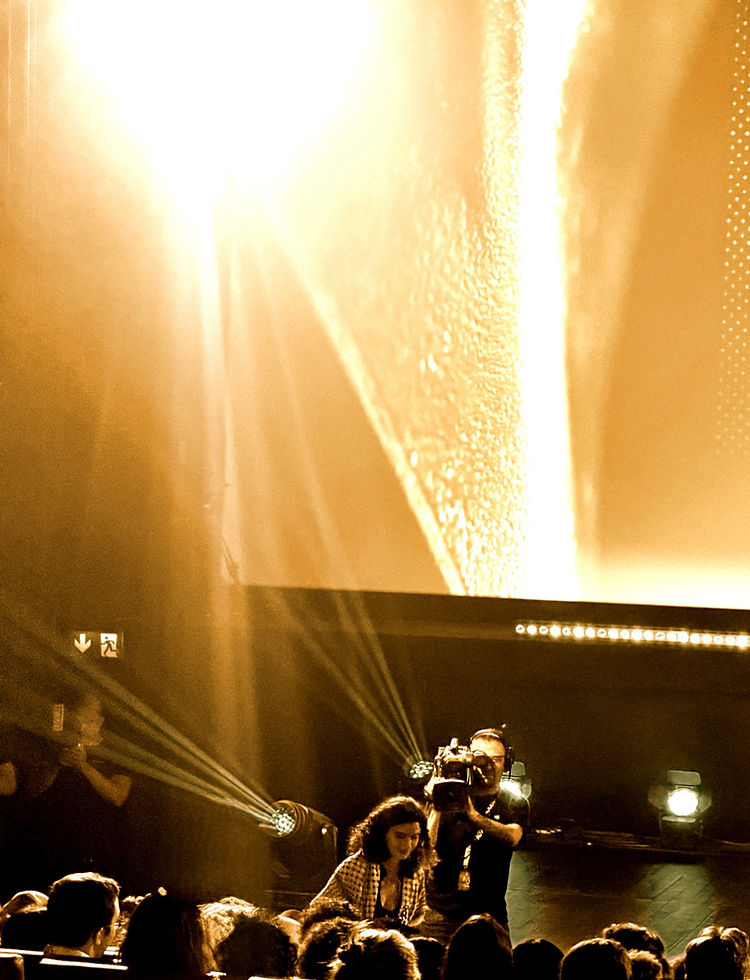
Issa’s acceptance speech at Locarno clarifies her relationship with the role. She explained that when she learned the film would exist somewhere between documentary and fiction, she no longer needed to pretend. She could be herself and bring the truth of the previous two years, along with her political and emotional burden, into the film.
Her statement suggests that Issa’s own experience deeply informs Hana. The sorrow captured by the camera is not merely an emotion designed for a fictional character; the film records part of the actor’s emotional reality.
Sibylle Bataille follows a different path in the role of Lisa. She must construct a character whose artistic past, professional skill, critical worldview, and concealed activity coexist within a single presence. Rather than relying on personal confession, her performance is built through physical control, rhythm, silence, and the careful withholding of information.
Manal Issa offers the film her personal truth; Sibylle Bataille uses the tools of acting to create an independent character. For me, Bataille’s gradual and controlled construction of Lisa leaves a stronger impression.
At its world premiere at the Locarno Film Festival, Summer Meadow received one award: the Pardo for Best Performance in the Cineasti del Presente section, presented to Manal Issa. The film, its directors, and Sibylle Bataille received no other award.
Without access to the jury’s deliberations, it would be unreasonable to describe the decision definitively as political. Nevertheless, Issa’s own explanation raises a valid question: to what extent did the festival reward an actor’s ability to create a distinct character, and to what extent did it honour authenticity, lived experience, and the social meaning attached to her presence?
The emotional value of Issa’s presence cannot be denied, but the festival’s decision remains debatable when considered strictly in terms of acting. Bataille creates a character whose different layers emerge gradually through controlled details. From this perspective, the award could reasonably have gone to her. The direction by Naël Khleifi and Lisa Debauche, which transforms a seemingly simple situation into a film about freedom, nature, and responsibility, also deserved separate recognition.
The Art of Living
Rather than making a direct film about Lebanon, war, or the victimhood of migrants, Khleifi and Debauche examine how a person might rediscover a way of living after an experience of compulsion. Their answer lies not in forgetting the past, but in reclaiming the ability to choose.
The title “To Nourish Life, One Must Leave the House” does not refer only to physically leaving a building. The house may be any enclosed space in which a person remains without making a decision: the memory of a country, guilt, fear of judgment, or a fixed image of oneself.
By the end, Hana has not found answers to all her questions, but she is no longer defined solely by a decision made for her during childhood. She can now consider what her next step might be. Rather than choosing a destination on her behalf, the film restores that possibility to her.
Summer Meadow suggests that freedom is not merely the act of crossing a border; it is the ability to choose the relationship one wishes to establish with the past, with a place, and with the surrounding world.


